

Loom Design --- Learn. Design. Explore. Validate.



Loom Design: The Open-Source toolkit for QEC
Loom Design is an open-source toolkit to design, simulate, and validate quantum error correction (QEC) frameworks. It makes QEC concepts visual, intuitive, and practical for students, educators, and researchers.
Loom Design brings together two powerful tools:
- Loom, an open-source Python library for building Quantum Error Correction (QEC) code primitives, and
- Entwine, a free-to-use, browser-based GUI for designing lattice surgery operations for surface and repetition codes.
Together, Entwine and Loom form a seamless workflow for designing, validating, and executing lattice surgery protocols. Entwine provides an interactive visual environment where you can explore and prototype ideas, while Loom offers the verification engine and programmatic backend that make those ideas rigorous and executable.
Out of the box, Loom Design includes several pre-built codes—such as the surface code and the repetition code—so you can start experimenting right away.
But that’s just the beginning. Loom can also be used as a standalone library, giving you fine-grained control over QEC primitives, including:
- 🧩 State preparation
- ⚡ Syndrome extraction circuits
- 🌀 Logical operations
- 🧮 Decoding routines
Whether you’re exploring the fundamentals of quantum error correction or fine-tuning the details of a complex experiment, Loom Design provides everything you need to bring your ideas to life.
The basic workflow
Design a lattice surgery circuit using Entwine, obtain loom code and simulate it with your choice of backend!
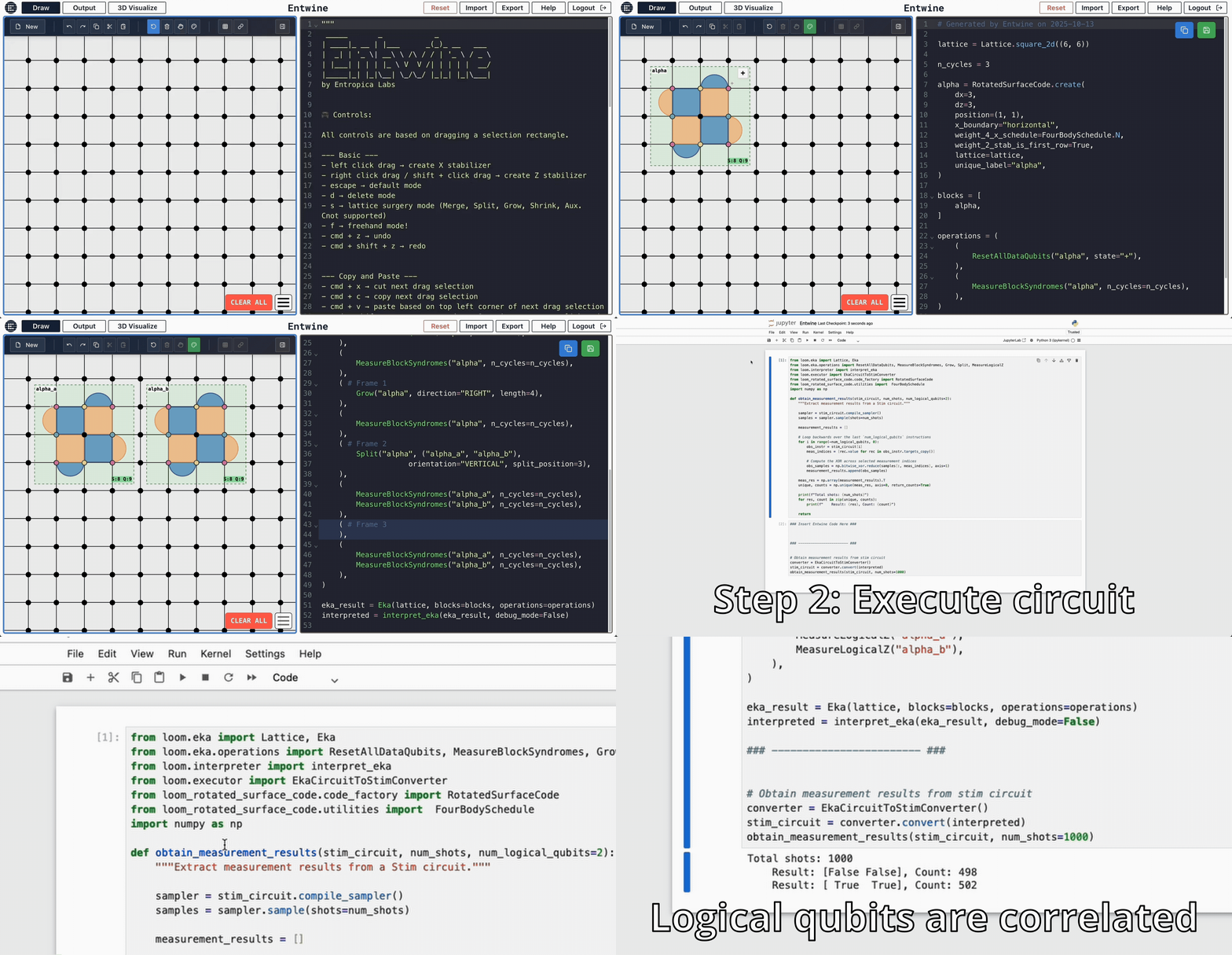
Loom Design Core Features
Using Entwine and Loom together gives you the best of both worlds:
-
Interactive exploration
Entwine is ideal for quickly sketching and testing out complex lattice surgery constructions, where having a visual interface makes it easier to reason about patch geometry and operations. -
Scalability
There is technically no limit to the number of patches you can define in Entwine.
In practice, once you go beyond about 60–70 patches, the visualisation becomes challenging to follow — but we’re eager to see how far users will push this. -
Bridging design and execution
By exporting Loom code, you can design the bulk of your logic interactively in Entwine, and then refine or extend it programmatically in Loom.
This workflow allows you to polish, automate, and reproduce your results with the precision of code.
The Sweet Spot
Entwine is the place to prototype and visualise. Loom is the place to validate and execute.
Together, they provide a complete workflow for anyone working with surface codes and lattice surgery — from the early sketch to the final simulation.
Documentation: https://loom-docs.entropicalabs.com
Source Code: https://github.com/entropicalabs/el-loom
API Reference https://loom-api-docs.entropicalabs.com/
Loom is open-source and developed by Entropica Labs in Singapore. Our inbox is always open and we are always on the lookput for new team memebers!